Mapping between coordinate systems
Mapping coordinate systems: cheatsheet
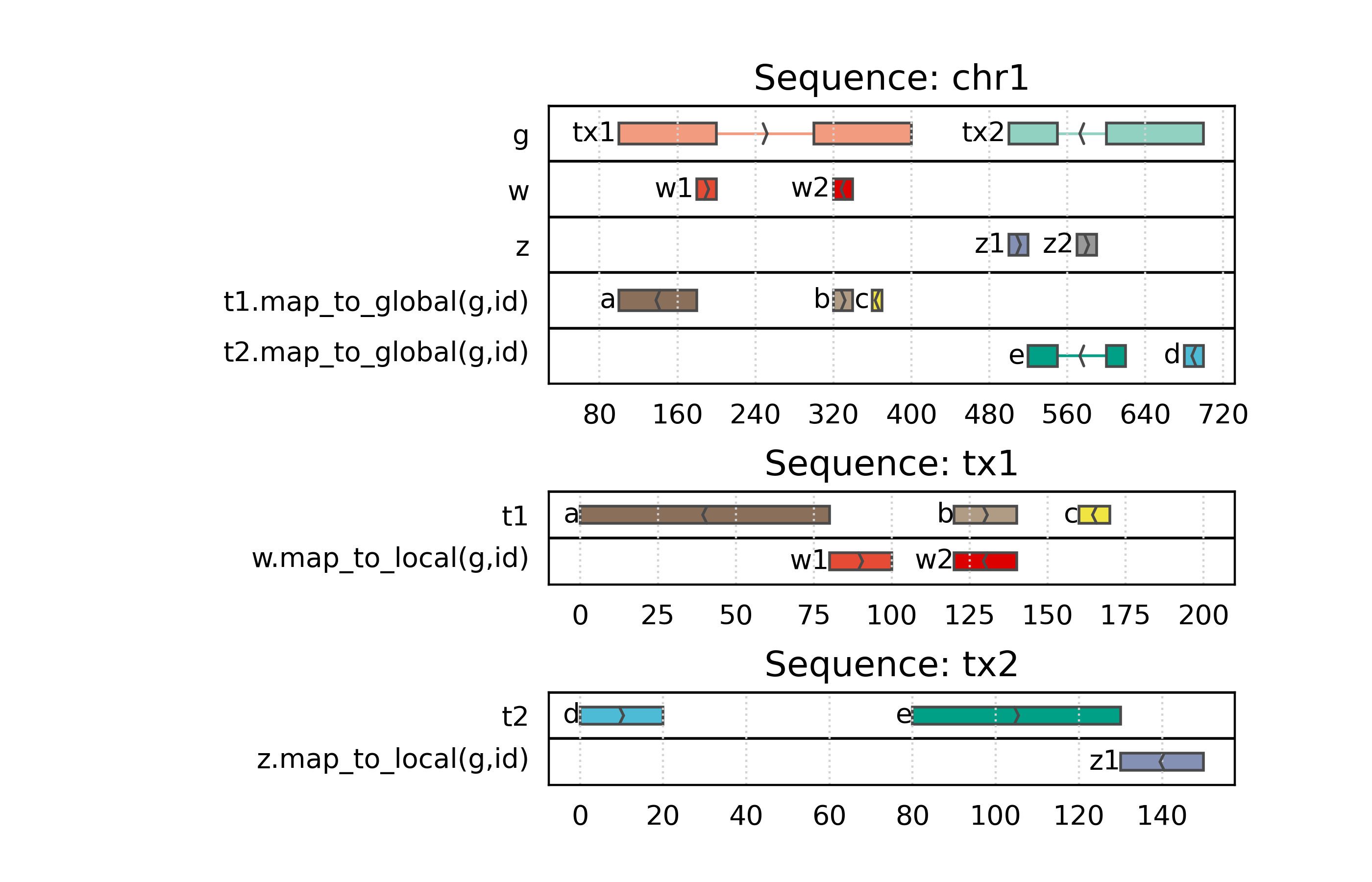
overlap.
Nested coordinate systems
PyRanges may represent nested coordinate systems, where the intervals in one coordinate system are relative to the intervals in another coordinate system. This is useful for representing hierarchical data.
Let’s make an intuitive case. On the one hand, we have some global ranges, that is genomic intervals wherein coordinates refer to positions along the genome:
>>> import pyranges1 as pr, pandas as pd
>>> gr = pr.example_data.ncbi_gff
>>> gre = (gr[gr.Feature=='exon']).get_with_loc_columns('Parent')
>>> gre
index    |    Chromosome         Start    End      Strand      Parent
int64    |    category           int64    int64    category    str
-------  ---  -----------------  -------  -------  ----------  ---------------------
3        |    CAJFCJ010000053.1  4882     5264     -           rna-DGYR_LOCUS13733
7        |    CAJFCJ010000053.1  10474    10958    +           rna-DGYR_LOCUS13734
8        |    CAJFCJ010000053.1  11028    11169    +           rna-DGYR_LOCUS13734
9        |    CAJFCJ010000053.1  11227    11400    +           rna-DGYR_LOCUS13734
...      |    ...                ...      ...      ...         ...
141      |    CAJFCJ010000025.1  2753     2851     -           rna-DGYR_LOCUS12552-2
142      |    CAJFCJ010000025.1  2593     2693     -           rna-DGYR_LOCUS12552-2
143      |    CAJFCJ010000025.1  2354     2537     -           rna-DGYR_LOCUS12552-2
144      |    CAJFCJ010000025.1  1909     2294     -           rna-DGYR_LOCUS12552-2
PyRanges with 57 rows, 5 columns, and 1 index columns.
Contains 3 chromosomes and 2 strands.
On the other hand, we have local data, i.e. mapped to the transcript sequences that are annotated in the global ranges.
Below, we load some example data that we obtained by running the Rfam database of RNA motifs against the
transcript sequences in the gre object, using the software Infernal:
>>> rh = pr.example_data.rfam_hits
>>> rh = rh[ ['target_name', 'seq_from', 'seq_to', 'strand', 'query_name', 'mdl_from', 'mdl_to'] ]
>>> rh.head()
             target_name  seq_from  seq_to strand query_name  mdl_from  mdl_to
0    rna-DGYR_LOCUS12552       267     311      +       GAIT         1      71
1  rna-DGYR_LOCUS12552-2       288     332      +       GAIT         1      71
2    rna-DGYR_LOCUS13738      1641    1678      +    REN-SRE         1      37
3    rna-DGYR_LOCUS14091       137      43      -  IFN_gamma         1     169
4    rna-DGYR_LOCUS14091       547     616      +     snoZ30         1      97
Above, the target_name column contains the transcript IDs, which are
the same as the ID column in the gre object. Then we have coordinates that define the alignment between
portions of those transcripts and one of the RNA motifs (query models) in the Rfam database.
Let’s convert the rh object to a PyRanges object, taking care of switching from 1-based to 0-based coordinates:
>>> rh = rh.rename(columns={'target_name':'Chromosome', 'seq_from':'Start', 'seq_to':'End', 'strand':'Strand'})
>>> rh = pr.PyRanges(rh)
>>> rh['Start'] -= 1  # convert to 0-based coordinates
>>> rh
index    |    Chromosome             Start    End      Strand    query_name    mdl_from    mdl_to
int64    |    str                    int64    int64    str       str           int64       int64
-------  ---  ---------------------  -------  -------  --------  ------------  ----------  --------
0        |    rna-DGYR_LOCUS12552    266      311      +         GAIT          1           71
1        |    rna-DGYR_LOCUS12552-2  287      332      +         GAIT          1           71
2        |    rna-DGYR_LOCUS13738    1640     1678     +         REN-SRE       1           37
3        |    rna-DGYR_LOCUS14091    136      43       -         IFN_gamma     1           169
...      |    ...                    ...      ...      ...       ...           ...         ...
31       |    rna-DGYR_LOCUS13737    549      600      +         mir-3047      1           61
32       |    rna-DGYR_LOCUS13737    543      605      +         mir-3156      1           77
33       |    rna-DGYR_LOCUS13737    529      612      +         MIR1523       1           92
34       |    rna-DGYR_LOCUS13737    549      600      +         MIR8001       1           67
PyRanges with 35 rows, 7 columns, and 1 index columns.
Contains 13 chromosomes and 2 strands.
Invalid ranges:
  * 15 intervals are empty or negative length (end <= start). See indexes: 3, 5, 6, ...
Infernal, like other programs, reports negative stranded hits with Start and End reversed. Let’s fix that:
>>> rh.loc[ rh.Strand == '-', ['Start', 'End'] ] = rh.loc[ rh.Strand == '-', ['End', 'Start'] ].values
>>> rh
index    |    Chromosome             Start    End      Strand    query_name    mdl_from    mdl_to
int64    |    str                    int64    int64    str       str           int64       int64
-------  ---  ---------------------  -------  -------  --------  ------------  ----------  --------
0        |    rna-DGYR_LOCUS12552    266      311      +         GAIT          1           71
1        |    rna-DGYR_LOCUS12552-2  287      332      +         GAIT          1           71
2        |    rna-DGYR_LOCUS13738    1640     1678     +         REN-SRE       1           37
3        |    rna-DGYR_LOCUS14091    43       136      -         IFN_gamma     1           169
...      |    ...                    ...      ...      ...       ...           ...         ...
31       |    rna-DGYR_LOCUS13737    549      600      +         mir-3047      1           61
32       |    rna-DGYR_LOCUS13737    543      605      +         mir-3156      1           77
33       |    rna-DGYR_LOCUS13737    529      612      +         MIR1523       1           92
34       |    rna-DGYR_LOCUS13737    549      600      +         MIR8001       1           67
PyRanges with 35 rows, 7 columns, and 1 index columns.
Contains 13 chromosomes and 2 strands.
Now we have the gre and rh objects, that represent global and local coordinate systems, respectively.
Let’s check that all Chromosome values in rh matches the ID column in gre:
>>> bool( rh.Chromosome.isin(gre.Parent).all() )
True
Mapping from local to global ranges
Next, we want to take the Rfam hits in rh, which are relative (local) to the transcript sequences,
and remap them to the genome (global) coordinates. To do so, we make use of the information in the gre object,
which defines the coordinates of each transcript, often split in exons, relative to the genome.
For this operation, we use the map_to_global method.
Besides the two PyRanges objects, we also need to specify the columns in the global range
that contains the identifier used as the Chromosome in the local range, provided by the global_on argument.
The resulting PyRanges object, rhg, contains the Rfam hits remapped to the genome coordinates:
>>> rhg = rh.map_to_global(gre, global_on='Parent')
>>> rhg
index    |    Chromosome         Start    End      Strand    query_name    mdl_from    mdl_to
int64    |    category           int64    int64    str       str           int64       int64
-------  ---  -----------------  -------  -------  --------  ------------  ----------  --------
0        |    CAJFCJ010000025.1  2598     2643     -         GAIT          1           71
1        |    CAJFCJ010000025.1  2598     2643     -         GAIT          1           71
2        |    CAJFCJ010000053.1  77544    77582    +         REN-SRE       1           37
3        |    CAJFCJ010000097.1  2291     2384     -         IFN_gamma     1           169
...      |    ...                ...      ...      ...       ...           ...         ...
31       |    CAJFCJ010000053.1  39708    39759    +         mir-3047      1           61
32       |    CAJFCJ010000053.1  39702    39764    +         mir-3156      1           77
33       |    CAJFCJ010000053.1  39688    39771    +         MIR1523       1           92
34       |    CAJFCJ010000053.1  39708    39759    +         MIR8001       1           67
PyRanges with 38 rows, 7 columns, and 1 index columns (with 3 index duplicates).
Contains 3 chromosomes and 2 strands.
Note that the transcript identifiers are now missing. To keep them, we can use the keep_id argument.
Analogously, we can record the local coordinates by using the keep_loc argument:
>>> rh.map_to_global(gre, global_on='Parent', keep_id=True, keep_loc=True).drop(
...    columns=['query_name', 'mdl_from','mdl_to']) # dropping some columns to allow display
index    |    Chromosome         Start    End      Strand    Parent                 Start_local    End_local    ...
int64    |    category           int64    int64    str       str                    int64          int64        ...
-------  ---  -----------------  -------  -------  --------  ---------------------  -------------  -----------  -----
0        |    CAJFCJ010000025.1  2598     2643     -         rna-DGYR_LOCUS12552    266            311          ...
1        |    CAJFCJ010000025.1  2598     2643     -         rna-DGYR_LOCUS12552-2  287            332          ...
2        |    CAJFCJ010000053.1  77544    77582    +         rna-DGYR_LOCUS13738    1640           1678         ...
3        |    CAJFCJ010000097.1  2291     2384     -         rna-DGYR_LOCUS14091    43             136          ...
...      |    ...                ...      ...      ...       ...                    ...            ...          ...
31       |    CAJFCJ010000053.1  39708    39759    +         rna-DGYR_LOCUS13737    549            600          ...
32       |    CAJFCJ010000053.1  39702    39764    +         rna-DGYR_LOCUS13737    543            605          ...
33       |    CAJFCJ010000053.1  39688    39771    +         rna-DGYR_LOCUS13737    529            612          ...
34       |    CAJFCJ010000053.1  39708    39759    +         rna-DGYR_LOCUS13737    549            600          ...
PyRanges with 38 rows, 8 columns, and 1 index columns (with 3 index duplicates). (1 columns not shown: "Strand_local").
Contains 3 chromosomes and 2 strands.
Let’s now map intervals relative to protein sequences to genome coordinates. First, we obtain the coding sequences (CDS) from the original GFF file, and translate them to protein sequences (see Working with sequences for details):
>>> grc = (gr[gr.Feature=='CDS']).get_with_loc_columns('ID')
>>> genome_file = pr.example_data.files['ncbi.fasta']
>>> cds_seq = grc.get_sequence(genome_file, group_by='ID').str.upper()
>>> pep_seq = pr.seqs.translate(cds_seq)
>>> pep_seq.head()
ID
cds-CAD5125114.1    MSRQSGRSNDPRKVSGELLTLTYGALVAQLVKDSESDDEVNKQLDK...
cds-CAD5125115.1    MGYNIGIRLIEDFLARSSIGKCKDLRETAEIISKNGFKMFLNITPI...
cds-CAD5126491.1    MAKNPEKMSATKKLETINRCMGHTKRGLENGCYTKGLIKIRCFTAE...
cds-CAD5126492.1    MKIFAIISIYFILSESCYFRNVEVEGDFYLATFLAFHTDEYCTGPI...
cds-CAD5126493.1    MNFYRNFFNLIFCIKVSSFSPIQDYISCQEALTKTEQDGSYSIKPR...
Name: Sequence, dtype: object
As an example of a positional feature mapped to protein sequences, let’s find all instances of the amino acid ‘K’ (lysine):
>>> aa='K'
>>> z = [(seq_id, i, aa)   for seq_id, seq in pep_seq.items()   for i, char in enumerate(seq)  if char == aa]
>>> z = pd.DataFrame(z, columns=['ID', 'Start', 'AminoAcid'])
>>> z.head()
                 ID  Start AminoAcid
0  cds-CAD5125114.1     12         K
1  cds-CAD5125114.1     31         K
2  cds-CAD5125114.1     41         K
3  cds-CAD5125114.1     45         K
4  cds-CAD5125114.1     66         K
- Let’s convert to a PyRanges object:
>>> aa_pos = pr.PyRanges(z.rename(columns={'ID':'Chromosome'}).assign(End=lambda df: df.Start + 1 ))
>>> aa_pos
index    |    Chromosome        Start    AminoAcid    End
int64    |    str               int64    str          int64
-------  ---  ----------------  -------  -----------  -------
0        |    cds-CAD5125114.1  12       K            13
1        |    cds-CAD5125114.1  31       K            32
2        |    cds-CAD5125114.1  41       K            42
3        |    cds-CAD5125114.1  45       K            46
...      |    ...               ...      ...          ...
457      |    cds-CAD5126878.1  334      K            335
458      |    cds-CAD5126878.1  341      K            342
459      |    cds-CAD5126878.1  342      K            343
460      |    cds-CAD5126878.1  350      K            351
PyRanges with 461 rows, 4 columns, and 1 index columns.
Contains 17 chromosomes.
Next, we have to convert protein-based positions to nucleotide-based positions, still relative to the CDS. Because they’re in pythonic 0-based coordinates, we just need to multiply by 3:
>>> cds_pos = aa_pos.copy()
>>> cds_pos['Start'] *= 3
>>> cds_pos['End'] *= 3
Now we’re ready to map these positions to the genome coordinates. Let’s also fetch their underlying nucleotide sequence:
>>> genome_pos = cds_pos.map_to_global(grc, global_on='ID', keep_id=True)
>>> genome_pos['Sequence'] = genome_pos.get_sequence(genome_file).str.upper()
>>> genome_pos
index    |    Chromosome         Start    AminoAcid    End      ID                Strand      Sequence
int64    |    category           int64    str          int64    str               category    object
-------  ---  -----------------  -------  -----------  -------  ----------------  ----------  ----------
0        |    CAJFCJ010000025.1  3114     K            3117     cds-CAD5125114.1  -           AAA
1        |    CAJFCJ010000025.1  2797     K            2800     cds-CAD5125114.1  -           AAG
2        |    CAJFCJ010000025.1  2767     K            2770     cds-CAD5125114.1  -           AAA
3        |    CAJFCJ010000025.1  2755     K            2758     cds-CAD5125114.1  -           AAA
...      |    ...                ...      ...          ...      ...               ...         ...
457      |    CAJFCJ010000097.1  53008    K            53011    cds-CAD5126878.1  +           AAG
458      |    CAJFCJ010000097.1  53341    K            53344    cds-CAD5126878.1  +           AAA
459      |    CAJFCJ010000097.1  53344    K            53347    cds-CAD5126878.1  +           AAA
460      |    CAJFCJ010000097.1  53368    K            53371    cds-CAD5126878.1  +           AAA
PyRanges with 466 rows, 7 columns, and 1 index columns (with 5 index duplicates).
Contains 3 chromosomes and 2 strands.
Because protein mapping to genome coordinates is common, map_to_map_to_global
provides a shortcut for this operation, through its pep_to_cds argument, which effectively multiplies the local
coordinates by 3 before mapping to the global coordinates. So this is equivalent to the previous operation:
>>> aa_pos.map_to_global(grc, global_on='ID', keep_id=True, pep_to_cds=True)
index    |    Chromosome         Start    AminoAcid    End      ID                Strand
int64    |    category           int64    str          int64    str               category
-------  ---  -----------------  -------  -----------  -------  ----------------  ----------
0        |    CAJFCJ010000025.1  3114     K            3117     cds-CAD5125114.1  -
1        |    CAJFCJ010000025.1  2797     K            2800     cds-CAD5125114.1  -
2        |    CAJFCJ010000025.1  2767     K            2770     cds-CAD5125114.1  -
3        |    CAJFCJ010000025.1  2755     K            2758     cds-CAD5125114.1  -
...      |    ...                ...      ...          ...      ...               ...
457      |    CAJFCJ010000097.1  53008    K            53011    cds-CAD5126878.1  +
458      |    CAJFCJ010000097.1  53341    K            53344    cds-CAD5126878.1  +
459      |    CAJFCJ010000097.1  53344    K            53347    cds-CAD5126878.1  +
460      |    CAJFCJ010000097.1  53368    K            53371    cds-CAD5126878.1  +
PyRanges with 466 rows, 6 columns, and 1 index columns (with 5 index duplicates).
Contains 3 chromosomes and 2 strands.
In the genetic code, the codons for lysine are ‘AAA’ or ‘AAG’, which fits what we see. One last important observation: note the warning above about index duplicates. Let’s take a look at them:
>>> genome_pos[genome_pos.index.duplicated(keep=False)]
index    |    Chromosome         Start    AminoAcid    End      ID                Strand      Sequence
int64    |    category           int64    str          int64    str               category    object
-------  ---  -----------------  -------  -----------  -------  ----------------  ----------  ----------
234      |    CAJFCJ010000053.1  77393    K            77395    cds-CAD5126496.1  +           AA
234      |    CAJFCJ010000053.1  77458    K            77459    cds-CAD5126496.1  +           G
282      |    CAJFCJ010000053.1  89719    K            89721    cds-CAD5126498.1  -           AA
282      |    CAJFCJ010000053.1  89660    K            89661    cds-CAD5126498.1  -           G
...      |    ...                ...      ...          ...      ...               ...         ...
422      |    CAJFCJ010000097.1  52381    K            52382    cds-CAD5126877.1  +           A
422      |    CAJFCJ010000097.1  52446    K            52448    cds-CAD5126877.1  +           AG
446      |    CAJFCJ010000097.1  52381    K            52382    cds-CAD5126878.1  +           A
446      |    CAJFCJ010000097.1  52446    K            52448    cds-CAD5126878.1  +           AG
PyRanges with 10 rows, 7 columns, and 1 index columns (with 5 index duplicates).
Contains 2 chromosomes and 2 strands.
This is because the codon for some amino acids are split between two exons. In more general terms, this is an effect of mapping local features to a global coordinate system: if entities (e.g. CDS) encompasses multiple non-contiguous intervals in the global coordinate system (e.g. exons), a certain local feature (e.g. amino acid) may also be mapped into split intervals in global coordinates. These are identified by the index duplicates in the PyRanges object, as above.
Mapping from global to local ranges
Another task is to map from global to local ranges, which is the opposite of the previous task. This is useful when we put together data generated at different levels. For example, we may have genomic features predicted using the full genome, and we want to see where they reside in transcripts. In this example, we will map the sequence ‘AATAAA’, which is a polyadenylation signal motif, in genome sequences, then map them to transcript coordinates.
>>> pattern='AATAAA'
Let’s remind ourselves of the gre object, which contains the transcript coordinates:
>>> gre
index    |    Chromosome         Start    End      Strand      Parent
int64    |    category           int64    int64    category    str
-------  ---  -----------------  -------  -------  ----------  ---------------------
3        |    CAJFCJ010000053.1  4882     5264     -           rna-DGYR_LOCUS13733
7        |    CAJFCJ010000053.1  10474    10958    +           rna-DGYR_LOCUS13734
8        |    CAJFCJ010000053.1  11028    11169    +           rna-DGYR_LOCUS13734
9        |    CAJFCJ010000053.1  11227    11400    +           rna-DGYR_LOCUS13734
...      |    ...                ...      ...      ...         ...
141      |    CAJFCJ010000025.1  2753     2851     -           rna-DGYR_LOCUS12552-2
142      |    CAJFCJ010000025.1  2593     2693     -           rna-DGYR_LOCUS12552-2
143      |    CAJFCJ010000025.1  2354     2537     -           rna-DGYR_LOCUS12552-2
144      |    CAJFCJ010000025.1  1909     2294     -           rna-DGYR_LOCUS12552-2
PyRanges with 57 rows, 5 columns, and 1 index columns.
Contains 3 chromosomes and 2 strands.
Let’s get the lengths of all these chromosomes from the genome:
>>> import pyfaidx
>>> pyf = pyfaidx.Fasta(genome_file)
>>> chromsizes = {chrom: len(pyf[chrom]) for chrom in gre.chromosomes}
>>> chromsizes
{'CAJFCJ010000025.1': 3418, 'CAJFCJ010000053.1': 109277, 'CAJFCJ010000097.1': 78757}
Let’s now create a PyRanges object than spans their whole sequence, with two intervals per chromosome: one for plus strand and one for minus strand; and let’s load their sequence in memory:
>>> q = [(chrom, 0, chromsizes[chrom], '+')  for chrom in chromsizes] + [(chrom, 0, chromsizes[chrom], '-') for chrom in chromsizes]
>>> q
[('CAJFCJ010000025.1', 0, 3418, '+'), ('CAJFCJ010000053.1', 0, 109277, '+'), ('CAJFCJ010000097.1', 0, 78757, '+'), ('CAJFCJ010000025.1', 0, 3418, '-'), ('CAJFCJ010000053.1', 0, 109277, '-'), ('CAJFCJ010000097.1', 0, 78757, '-')]
>>> full_seq = pr.PyRanges( pd.DataFrame(q, columns=['Chromosome', 'Start', 'End', 'Strand']))
>>> full_seq['Sequence'] = full_seq.get_sequence(genome_file).str.upper()
>>> matches = []
>>> for i in full_seq.itertuples():
...    st=0
...    while (pos_match:= i.Sequence.find(pattern, st)) != -1:
...        pat_st, pat_end = pos_match, pos_match+len(pattern)
...        if i.Strand == '-':
...          pat_st, pat_end = i.End - (pos_match + len(pattern)), i.End - pos_match
...        matches.append( (i.Chromosome, pat_st, pat_end, i.Strand) )
...        st=pos_match+1
>>> matches = pr.PyRanges( pd.DataFrame(matches, columns=['Chromosome', 'Start', 'End', 'Strand']))
>>> matches['Sequence'] = matches.get_sequence(genome_file).str.upper() # fetch seq as control
>>> matches
index    |    Chromosome         Start    End      Strand    Sequence
int64    |    str                int64    int64    str       object
-------  ---  -----------------  -------  -------  --------  ----------
0        |    CAJFCJ010000025.1  81       87       +         AATAAA
1        |    CAJFCJ010000025.1  90       96       +         AATAAA
2        |    CAJFCJ010000025.1  347      353      +         AATAAA
3        |    CAJFCJ010000025.1  553      559      +         AATAAA
...      |    ...                ...      ...      ...       ...
619      |    CAJFCJ010000097.1  2513     2519     -         AATAAA
620      |    CAJFCJ010000097.1  2284     2290     -         AATAAA
621      |    CAJFCJ010000097.1  2163     2169     -         AATAAA
622      |    CAJFCJ010000097.1  858      864      -         AATAAA
PyRanges with 623 rows, 5 columns, and 1 index columns.
Contains 3 chromosomes and 2 strands.
The object matches contains the positions of the motif in the genome.
Now, we want to map these positions to the transcript coordinates. Function
map_to_local does exactly this.
For each motif, we need to decide which transcript we want to use as reference
coordinate system. By default, it will use all transcripts that overlap the motif:
>>> gre_matches = matches.map_to_local(gre, ref_on='Parent')
>>> gre_matches
index    |    Chromosome           Start    End      Strand    Sequence
int64    |    str                  int64    int64    str       object
-------  ---  -------------------  -------  -------  --------  ----------
28       |    rna-DGYR_LOCUS13734  1142     1148     +         AATAAA
29       |    rna-DGYR_LOCUS13734  1416     1422     +         AATAAA
30       |    rna-DGYR_LOCUS13734  2106     2112     +         AATAAA
31       |    rna-DGYR_LOCUS13734  2232     2238     +         AATAAA
...      |    ...                  ...      ...      ...       ...
617      |    rna-DGYR_LOCUS14091  980      986      -         AATAAA
618      |    rna-DGYR_LOCUS14091  774      780      -         AATAAA
619      |    rna-DGYR_LOCUS14091  265      271      -         AATAAA
620      |    rna-DGYR_LOCUS14091  36       42       -         AATAAA
PyRanges with 59 rows, 5 columns, and 1 index columns (with 2 index duplicates).
Contains 14 chromosomes and 2 strands.
åAs before, you have options to retain metadata, in this case from the global ranges:
>>> matches.map_to_local(gre, ref_on='Parent', keep_chrom=True, keep_loc=True).columns
Index(['Chromosome', 'Start', 'End', 'Strand', 'Sequence', 'Chromosome_global',
       'Start_global', 'End_global', 'Strand_global'],
      dtype='str')
Let’s look at another use case. For example, we way have CDS and exon coordinates, and we want to map the CDS coordinates to the exon coordinates. In other words, we want to know where CDS intervals reside along the full mRNA transcripts.
Let’s inspect some data inside the gr object, focusing on a single identifier:
>>> pr.options.set_option('max_rows_to_show', 20)
>>> some_id = 'rna-DGYR_LOCUS12552-2'
>>> gr[gr.Parent == some_id].get_with_loc_columns(['Feature', 'Parent'])
  index  |    Chromosome           Start      End  Strand      Feature     Parent
  int64  |    category             int64    int64  category    category    str
-------  ---  -----------------  -------  -------  ----------  ----------  ---------------------
    140  |    CAJFCJ010000025.1     3111     3250  -           exon        rna-DGYR_LOCUS12552-2
    141  |    CAJFCJ010000025.1     2753     2851  -           exon        rna-DGYR_LOCUS12552-2
    142  |    CAJFCJ010000025.1     2593     2693  -           exon        rna-DGYR_LOCUS12552-2
    143  |    CAJFCJ010000025.1     2354     2537  -           exon        rna-DGYR_LOCUS12552-2
    144  |    CAJFCJ010000025.1     1909     2294  -           exon        rna-DGYR_LOCUS12552-2
    145  |    CAJFCJ010000025.1     3111     3153  -           CDS         rna-DGYR_LOCUS12552-2
    146  |    CAJFCJ010000025.1     2753     2851  -           CDS         rna-DGYR_LOCUS12552-2
    147  |    CAJFCJ010000025.1     2593     2693  -           CDS         rna-DGYR_LOCUS12552-2
    148  |    CAJFCJ010000025.1     2354     2537  -           CDS         rna-DGYR_LOCUS12552-2
    149  |    CAJFCJ010000025.1     2174     2294  -           CDS         rna-DGYR_LOCUS12552-2
PyRanges with 10 rows, 6 columns, and 1 index columns.
Contains 1 chromosomes and 1 strands.
You can see that CDS and exon belonging to the same transcript have the same Parent value.
Therefore, we can easily map the CDS coordinates to the exon coordinates of the corresponding transcript,
by pairing (overlapping) CDS and exon intervals with the same Parent value:
>>> pr.options.reset_options()
>>> cds = gr[gr.Feature == 'CDS'].get_with_loc_columns(['Feature', 'Parent'])
>>> exons = gr[gr.Feature == 'exon'].get_with_loc_columns(['Feature', 'Parent'])
>>> cds_local = cds.map_to_local(exons, ref_on='Parent', match_by='Parent')
>>> cds_local
index    |    Chromosome             Start    End      Strand    Feature
int64    |    str                    int64    int64    str       category
-------  ---  ---------------------  -------  -------  --------  ----------
0        |    rna-DGYR_LOCUS13733    1        382      +         CDS
1        |    rna-DGYR_LOCUS13734    258      484      +         CDS
2        |    rna-DGYR_LOCUS13734    484      625      +         CDS
3        |    rna-DGYR_LOCUS13734    625      798      +         CDS
...      |    ...                    ...      ...      ...       ...
52       |    rna-DGYR_LOCUS12552-2  139      237      +         CDS
53       |    rna-DGYR_LOCUS12552-2  237      337      +         CDS
54       |    rna-DGYR_LOCUS12552-2  337      520      +         CDS
55       |    rna-DGYR_LOCUS12552-2  520      640      +         CDS
PyRanges with 56 rows, 5 columns, and 1 index columns.
Contains 17 chromosomes and 1 strands.
>>> cds_local[cds_local.Chromosome == some_id]
  index  |    Chromosome               Start      End  Strand    Feature
  int64  |    str                      int64    int64  str       category
-------  ---  ---------------------  -------  -------  --------  ----------
     51  |    rna-DGYR_LOCUS12552-2       97      139  +         CDS
     52  |    rna-DGYR_LOCUS12552-2      139      237  +         CDS
     53  |    rna-DGYR_LOCUS12552-2      237      337  +         CDS
     54  |    rna-DGYR_LOCUS12552-2      337      520  +         CDS
     55  |    rna-DGYR_LOCUS12552-2      520      640  +         CDS
PyRanges with 5 rows, 5 columns, and 1 index columns.
Contains 1 chromosomes and 1 strands.
With the similar logic, we can easily map the start and stop codon positions to the exon coordinates:
>>> cds.slice_ranges(0, 3).assign(Feature='start').map_to_local(exons, ref_on='Parent', match_by='Parent')
index    |    Chromosome             Start    End      Strand    Feature
int64    |    str                    int64    int64    str       str
-------  ---  ---------------------  -------  -------  --------  ---------
0        |    rna-DGYR_LOCUS13733    1        4        +         start
1        |    rna-DGYR_LOCUS13734    258      261      +         start
2        |    rna-DGYR_LOCUS13734    484      487      +         start
3        |    rna-DGYR_LOCUS13734    625      628      +         start
...      |    ...                    ...      ...      ...       ...
52       |    rna-DGYR_LOCUS12552-2  139      142      +         start
53       |    rna-DGYR_LOCUS12552-2  237      240      +         start
54       |    rna-DGYR_LOCUS12552-2  337      340      +         start
55       |    rna-DGYR_LOCUS12552-2  520      523      +         start
PyRanges with 56 rows, 5 columns, and 1 index columns.
Contains 17 chromosomes and 1 strands.
>>> cds.slice_ranges(-3).assign(Feature='stop').map_to_local(exons, ref_on='Parent', match_by='Parent')
index    |    Chromosome             Start    End      Strand    Feature
int64    |    str                    int64    int64    str       str
-------  ---  ---------------------  -------  -------  --------  ---------
0        |    rna-DGYR_LOCUS13733    379      382      +         stop
1        |    rna-DGYR_LOCUS13734    481      484      +         stop
2        |    rna-DGYR_LOCUS13734    622      625      +         stop
3        |    rna-DGYR_LOCUS13734    795      798      +         stop
...      |    ...                    ...      ...      ...       ...
52       |    rna-DGYR_LOCUS12552-2  234      237      +         stop
53       |    rna-DGYR_LOCUS12552-2  334      337      +         stop
54       |    rna-DGYR_LOCUS12552-2  517      520      +         stop
55       |    rna-DGYR_LOCUS12552-2  637      640      +         stop
PyRanges with 56 rows, 5 columns, and 1 index columns.
Contains 17 chromosomes and 1 strands.